Student working paper · October 2026
10 agents.
One call.
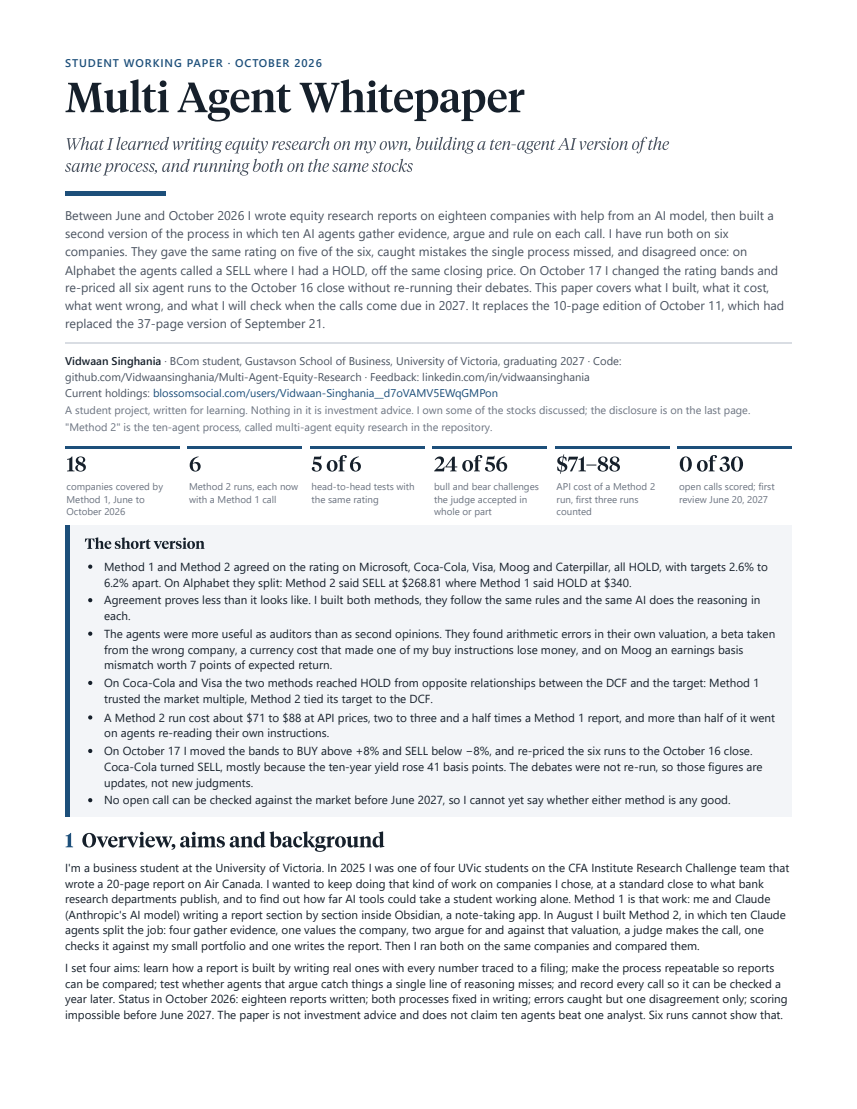
I wrote equity research on eighteen companies with an AI model, then built a version where ten agents gather evidence, argue and rule on each call. I ran both on the same stocks. This is what I learned.
- 10Agents, in 8 stages
- 5 of 6Same rating as my own research
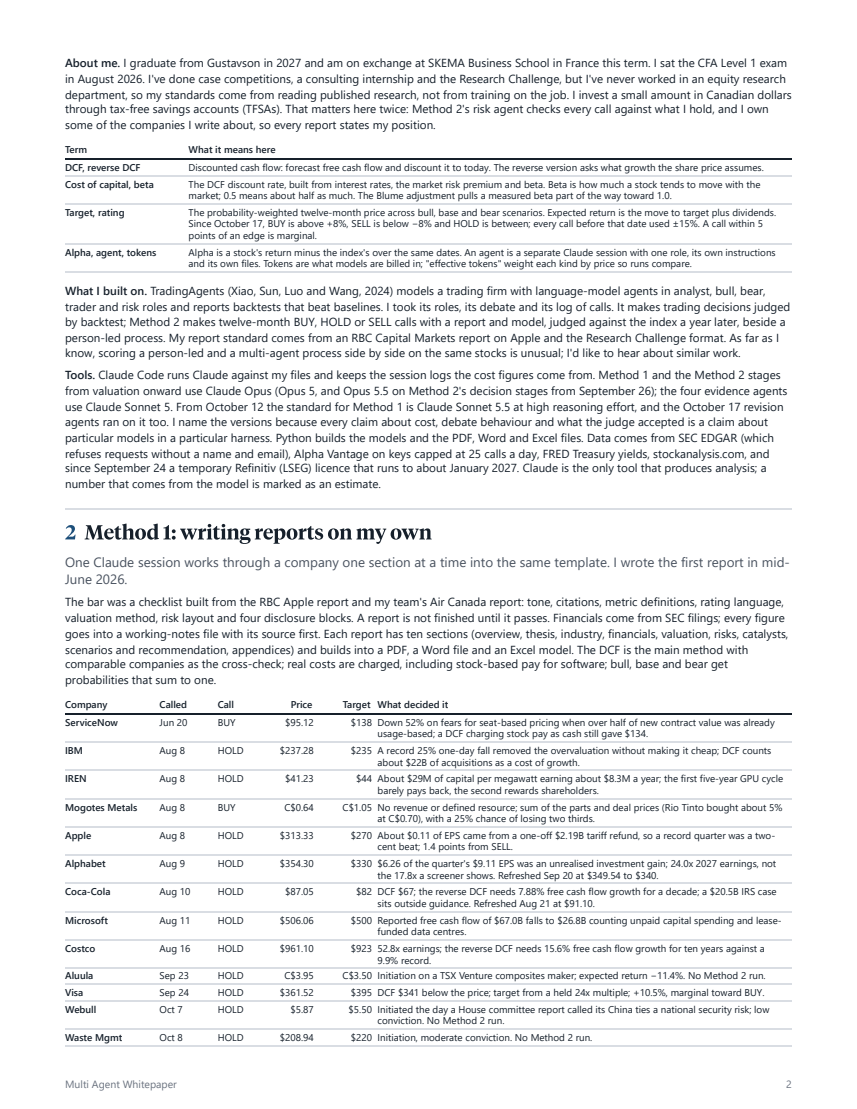
- 18Companies in my own research
- 0 of 30Calls scored. First review 20 June 2027
The pipeline
Evidence, base case, debate, ruling.
A person running Claude Code sequences the stages and builds the files. The agents do the analysis, and each run ends in a typed decision record.
- 01
Evidence
Four analysts work at the same time, and none sees another's output.
- Fundamentals
- Market
- News
- Industry
- 02
Base case
One valuation agent builds the numbers the judge rules on. It may not state a rating.
- Discounted cash flow
- Comparables cross-check
- Three weighted scenarios
- 03
Debate
A bull and a bear each attack the base case on the same model, at the same time.
- Name an assumption
- Compute what a new value does
- Neither can answer the other
- 04
Judgment
The judge maps the probability-weighted twelve-month return onto three bands.
- BUY
- HOLD
- SELL
- 05
Risk gate
A portfolio check, not a fourth opinion. It cannot change the rating.
- Concentration
- Correlation with holdings
- Currency round trip
- 06
Report
A writer publishes the report, the model workbook and every agent's output.
- Report PDF
- Model XLSX
- Workpapers DOCX
Preflight and close make eight stages in all. The full description is in the repo's pipeline notes.
Multi Agent Whitepaper · 10 pages
Read what I found.
Agreement proves less than it looks like, because I built both methods and the same AI reasons in each. The agents were more useful as auditors than as second opinions.
If the viewer is blank in your browser, open the PDF directly. Pages 1 and 2 are shown on small screens.